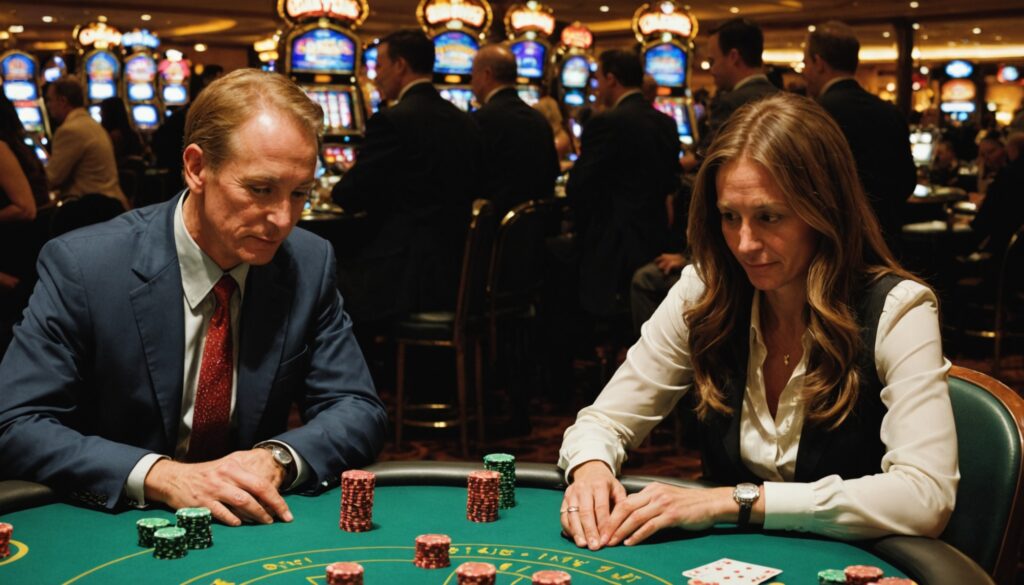
Chasing losses is the single most expensive habit in gambling, and I know because I’ve done it repeatedly.
There. That’s the honest version. Not “here are some tips to gamble responsibly” with a stock photo of someone looking pensive at a roulette table. I mean actually sitting at a blackjack table at midnight, down £200, telling yourself one more buy-in will sort it all out. I’ve been that person. More than once. Probably more than I’m even comfortable writing down.
This isn’t a lecture. I still gamble recreationally and I enjoy it. But chasing losses casino psychology is something worth talking about properly — because understanding what’s happening in your head is genuinely the only thing that ever helped me slow it down.
What “Chasing Losses” Actually Means (Beyond the Obvious)
Most people know the phrase. You lose money, you try to win it back by gambling more. Simple enough. But the reality of it is messier than that clean definition suggests.
Chasing isn’t always dramatic. It doesn’t always look like a bloke maxing out his credit card in a casino at 3am. Sometimes it’s quieter than that. It’s staying an extra hour when you’d planned to leave. It’s doubling your stakes “just for a bit” because you’re down. It’s switching games because you’re convinced the one you’re on is cold.
All of that is chasing. The common thread isn’t the amount — it’s the motivation. You’re no longer gambling because it’s fun. You’re gambling to undo something. That shift in mindset is where things go wrong, and it happens faster than you’d think.
The Night That Made Me Actually Think About This
I’ll give you a specific example because vague confessions are useless.
About two years ago I was at a casino in Manchester with a mate. Started the night well — up about £180 on roulette, which felt great. Then it turned. Lost it back, then another £100 on top. Fine, that happens. But instead of walking away, I moved to blackjack convinced I could “play properly” and recover.
I lost another £150 there. Moved back to roulette. Lost £100 more. By the end of the night I was down about £430 from my peak, which included wiping out the £180 I’d already won. Total net loss on the night: around £250.
The kicker? At multiple points during that session I could have walked away down £50 or even flat. But I didn’t, because my brain had locked onto the £180 I’d already had in my hand as “my money” — money I was now owed back by the universe or the casino or whoever.
That’s not how gambling works. But that’s absolutely how gambling feels when you’re in it.
Why Your Brain Does This — The Psychology Behind Chasing
There’s a concept in behavioural economics called loss aversion, and it’s the engine underneath most of this. The basic idea is that losing something hurts about twice as much psychologically as gaining the same amount feels good. So a £100 loss doesn’t feel like the mirror image of a £100 win — it feels significantly worse.
When you’ve lost money gambling, your brain is in a kind of pain. And it will tell you all sorts of things to make that pain stop:
- “You were up earlier, so you know you can win here.” (Irrelevant. Past results mean nothing.)
- “One good run and you’re back to even.” (Maybe. Or you go deeper.)
- “You’ve already lost this much, what’s another £50?” (This is the sunk cost fallacy in its purest form.)
- “You’ll feel worse leaving down than if you try to fix it.” (Short-term thinking that ignores how much worse you’ll feel if you lose more.)
These aren’t stupid thoughts. They feel completely logical in the moment. That’s what makes chasing losses gambling so dangerous — it doesn’t feel like a mistake while you’re doing it. It feels like the only sensible course of action.
Add in the fact that casinos are designed specifically to keep you in that state — no clocks, free drinks, the constant near-miss on the slots — and you’ve got a genuinely difficult psychological environment to navigate.
The Triggers I’ve Learned to Recognise in Myself
Everyone’s a bit different, but here are the specific things that tend to tip me from “having a decent night out” into “chasing losses” mode. I’m sharing mine because recognising your own patterns is step one.
- The phantom win. Being up and then losing it back feels worse than just losing from the start. That money felt real. Losing it triggers something extra.
- A bad beat on a “good” decision. If I play basic strategy correctly and still lose, something in me wants to keep going to “prove” the right play pays off eventually. It does, statistically — but not on demand.
- Drinking. Not hammered, just a couple of pints in. Enough to loosen the rational part of my decision-making while I still feel perfectly clear-headed. Casinos know this.
- Going alone. Without someone to say “right, let’s go,” I’ll talk myself into another hour easily.
- A specific losing number. Sounds daft but I’ve definitely sat at roulette chasing a particular colour or number that “hasn’t come in” for a while. Gambler’s fallacy, textbook stuff, still fell for it.
What Actually Helped Me Reduce It
I want to be straight with you: I haven’t eliminated this completely. I still have nights where I go a bit longer than I should. But it’s significantly better than it was, and here’s what actually moved the needle for me — not in a “set a budget” leaflet kind of way, but genuinely.
Deciding my loss limit before I walk in, not after
This sounds obvious but the important bit is the timing. Deciding you’ll stop at £100 down when you’re already £80 down is too late — your brain is already compromised. Deciding it before you sit down, when you’re calm, makes it feel more like a rule you set rather than a restriction someone’s imposing mid-session.
Physically leaving the building when I hit it
Not going to the bar. Not watching someone else play. Actually leaving. Even if it’s just to stand outside for five minutes, the change of environment breaks the mental loop. Half the time I don’t even want to go back in once I’m out in the air.
Writing down what I lost and how I felt about it the next morning
This one’s a bit odd but it helped. The morning-after version of me is a much better judge of whether the extra hour was worth it than the in-session version. Reading back through a few of those entries made me realise how consistent the pattern was. That consistency was sobering.
Reframing what I’m paying for
I’ve started thinking of my gambling budget as the cost of entertainment, same as a gig or a meal out. If I lose £80 and had a fun evening, that’s not a failure — that’s what I paid for the experience. That mental shift makes it easier to walk away without feeling like I’ve been cheated out of something.
An Honest Conclusion
I’m not going to wrap this up with “always gamble responsibly” because that phrase has been repeated so many times it means nothing anymore. What I will say is this: chasing losses casino psychology is real, it’s well-documented, and it’s not a sign of weakness or stupidity that you’ve fallen into it. It’s a sign you’re human and your brain is working exactly as designed — just in a context where that design works against you.
The casinos aren’t doing anything illegal. But they absolutely understand gambling psychology better than most players do, and they’ve built their entire environment around it. The only realistic counter is to understand your own brain just as well.
I still go to casinos. I still enjoy it. But I go in knowing that the moment I start thinking about getting money back rather than having a good time, something has shifted — and that’s the cue to cash out, not to double down.
Most of the time I listen to that now. Most of the time.